
Immigration News & Updates
Right to Work Check in the US: What It Really Means, Legal Requirements, and How to Do It Correctly

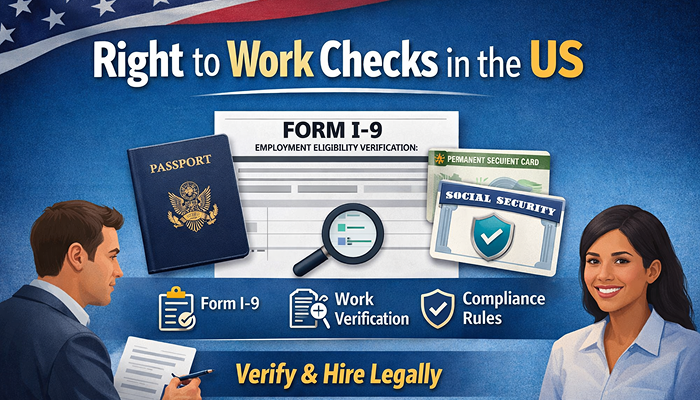
Hiring in the United States comes with a quiet but serious responsibility: making sure the people you employ are legally allowed to work. Many employers, job seekers, and even HR professionals search for a right to work check when they’re trying to understand that responsibility, what it involves, who it applies to, and how to do it without getting tripped up by legal or compliance issues.
The confusion is understandable. The phrase sounds official. It feels legal. But in the US, it’s more of a conversational shortcut than a defined process. And shortcuts, especially legal ones, are where mistakes happen.
This guide exists to replace uncertainty with clarity. We’ll unpack what employers are actually required to do, which laws apply, what paperwork matters, and how to verify work authorization correctly without crossing legal or ethical lines. No jargon for jargon’s sake. No fear-based compliance talk. Just clear, accurate information you can use.
What Is a Right to Work Check in the United States?
Despite how often the phrase is used, there is no single process in US law officially called a “right to work check.” Instead, the term is commonly used to describe employment eligibility verification, the legally required process employers must follow to confirm that every employee is authorized to work in the United States.
This requirement applies to all employees, regardless of citizenship, background, or role. If someone is on your payroll, they must be verified. That includes US-born citizens, naturalized citizens, permanent residents, and non-citizens with temporary work authorization.
The key distinction here is important:
Employers verify authorization to work, not immigration status. The law is designed to ensure that businesses hire legally while also protecting workers from discrimination.
This verification process happens after a job offer is accepted, not before. Employers may not pre-screen candidates based on nationality, accent, or perceived immigration status. Doing so can violate federal anti-discrimination laws, even if the employer believes they’re acting cautiously.
So when people talk about checking someone’s “right to work,” what they’re really talking about is complying with federal employment eligibility rules in a way that is consistent, fair, and legally sound.
Understanding Employment Eligibility Verification Under US Law
The foundation of work authorization verification in the US comes from the Immigration Reform and Control Act of 1986 (IRCA). This law made it illegal for employers to knowingly hire or continue employing individuals who are not authorized to work in the country.
IRCA did two important things at once:
- It placed responsibility on employers to verify employment eligibility
- It prohibited discrimination based on citizenship or national origin
That balance is intentional. Employers must verify, but they must do so uniformly and without bias.
Under this law, employers are required to:
- Verify the identity and employment authorization of every new hire
- Complete and retain verification documentation
- Make records available for inspection if requested by the government
Enforcement is handled by multiple agencies, including:
- US Citizenship and Immigration Services (USCIS)
- Immigration and Customs Enforcement (ICE)
- Department of Justice (DOJ) for discrimination-related violations
The takeaway here is simple: verification is mandatory, but how you conduct it matters just as much as whether you do it at all.
Form I-9: The Foundation of Work Authorization Verification
At the center of employment eligibility verification is Form I-9. Every employer in the US must complete this form for each employee hired after November 6, 1986.
The form itself is not submitted to the government routinely. Instead, it’s kept on file and produced if an audit or inspection occurs. That makes accuracy essential, because errors tend to surface at the worst possible moment.
How Form I-9 Works
Form I-9 has three sections:
Section 1 – Employee Information and Attestation
Completed by the employee no later than their first day of work. The employee attests, under penalty of perjury, that they are authorized to work.
Section 2 – Employer Review and Verification
Completed by the employer within three business days of the employee’s first day. This is where documents are reviewed.
Section 3 – Reverification and Rehires
Used when an employee’s work authorization expires or when rehiring occurs.
Employer Responsibilities
Employers must:
- Examine original documents (not copies, unless an exception applies)
- Confirm the documents appear genuine and relate to the employee
- Complete the form accurately and on time
- Store I-9s securely for the required retention period
Common Mistakes
Some of the most frequent issues include:
- Missing signatures or dates
- Accepting expired documents
- Asking for specific documents
- Failing to reverify when required
None of these errors require bad intent to cause real consequences. Most are the result of misunderstanding, or rushing through a process that deserves care.
Acceptable Documents for Verifying the Right to Work
Employees choose which documents to present, not employers. This is one of the most misunderstood aspects of verification.
Form I-9 categorizes documents into three lists:
List A – Documents that establish both identity and work authorization
Examples include a US passport or a permanent resident card.
List B – Documents that establish identity only
Such as a driver’s license or state ID.
List C – Documents that establish work authorization only
Such as a Social Security card (with no restrictions).
Employees may present:
- One document from List A, or
- One document from List B and one from List C
Employers may not:
- Demand a specific document
- Reject valid documents because they “look foreign”
- Ask for extra documentation
Expired documents are generally not acceptable, with limited exceptions. Reverification is required only when work authorization expires, not for US passports or permanent resident cards.
E-Verify vs Form I-9: Key Differences Employers Must Know
E-Verify is an online system that compares information from Form I-9 against government records. It’s designed to confirm work authorization, but it does not replace Form I-9.
For most employers, E-Verify is optional. However, it may be mandatory for:
- Federal contractors
- Employers in certain states
- Employers subject to specific local laws
Even when used, E-Verify:
- Must follow completion of Form I-9
- Applies only to new hires
- Cannot be used selectively
Think of E-Verify as a supplement, not a substitute.
Right-to-Work Laws vs Employment Authorization Checks
Here’s where confusion spikes.
Right-to-work laws have nothing to do with employment eligibility or immigration. They regulate whether employees can be required to join or financially support a union as a condition of employment.
These laws are determined at the state level and focus on labor relations, not hiring authorization. Conflating the two leads to misunderstandings that can affect both compliance and employee trust.
- One deals with who you can hire.
- The other deals with what unions can require.
- They are legally and practically separate.
How Employers Conduct a Right to Work Check Step by Step
Employers often ask for a simple checklist. Here it is, without shortcuts:
- Make a job offer
- Have the employee complete Section 1 of Form I-9
- Review original documents in person or through an approved alternative process
- Complete Section 2 accurately and on time
- Store the form securely
- Reverify only when required
Consistency matters. Every employee goes through the same process, every time. That’s how compliance becomes routine instead of risky.
Penalties for Failing to Verify Work Authorization Properly
Failure to comply can lead to:
- Civil fines per violation
- Criminal penalties for patterns of abuse
- Government audits
- Loss of contracts
- Reputational damage
Most penalties stem from paperwork errors, not intentional wrongdoing. Which is why training and process matter more than panic.
What Employees and Job Seekers Should Expect
Verification is normal. It’s not personal. Employees should expect:
- To complete Form I-9 after accepting an offer
- To choose which valid documents to present
- Equal treatment regardless of background
If something feels inconsistent or discriminatory, employees have the right to ask questions, and to be treated fairly.
Conclusion: Staying Compliant With US Work Authorization Requirements
Understanding what employers really mean when they refer to a right to work check is less about memorizing rules and more about respecting the system behind them. Employment eligibility verification exists to protect businesses, workers, and the integrity of the workforce itself.
When done correctly, it becomes a quiet, reliable part of hiring, one that doesn’t interrupt trust or workflow. When done carelessly, it creates risk that no business needs.
Accuracy, consistency, and fairness aren’t just legal ideals. They’re practical ones. And they’re the difference between compliance as a burden and compliance as good business practice.
Frequently Asked Questions
Is verification required for US citizens?
Yes. Every employee must be verified.
Can employers verify before making a job offer?
No. Verification happens after an offer is accepted.
How long must Form I-9 be kept?
Three years after hire or one year after termination, whichever is later.
Are remote workers verified differently?
Rules exist, but compliance standards remain the same.
Do independent contractors require verification?
No. But misclassification carries its own risks.


Immigration News & Updates
The Digital Nomad Visa Explained: How Americans Can Work Abroad Legally (Without Guesswork)

For years, the internet sold Americans a half-truth: Work from anywhere. What it left out was the fine print, immigration rules, tax realities, and the difference between permission and tolerance. Enter the digital nomad visa, a policy response to a world that finally noticed millions of people were earning online while living offline somewhere else.
If you’re based in the US and working remotely, you’re not looking for escapism. You’re looking for clarity. You want to know whether you can stay longer than 90 days without sweating at border control, whether you’re allowed to open a bank account, and whether doing this “the right way” will quietly wreck your taxes. This guide exists for that exact reason.
No hype. No lifestyle gloss. Just clear explanations, written for Americans who want to understand the rules before they book the flight.
What Is a Digital Nomad Visa?
At its simplest, this visa category is a legal framework that allows a foreign national to live in a country while earning income from outside that country. You are not entering the local job market. You are not competing with local workers. You are bringing your income with you.
That distinction matters.
Most countries created these programs after realizing two things:
- Remote work was permanent.
- Long-stay tourists were already working quietly, and illegally.
So instead of pretending it wasn’t happening, governments built a new lane.
How it differs from other visas
- Tourist visas allow presence, not productivity. Working while on one, yes, even on your laptop, is typically prohibited.
- Traditional work visas require a local employer and sponsorship.
- Residency permits often assume local economic participation or long-term settlement.
This newer visa type sits in between. It’s temporary, renewable in many cases, and explicitly designed for location-independent income earners.
Typical features
- Duration ranging from 6 months to 2 years
- Proof of minimum income (thresholds vary widely)
- Mandatory health insurance
- Clean criminal record
- No pathway to citizenship (in most cases)
It’s not a loophole. It’s a contract: We’ll let you stay. You agree to follow our rules.
Who Qualifies, and Who Usually Doesn’t
Eligibility isn’t about job titles. It’s about income structure.
Americans who usually qualify
- Fully remote W-2 employees
- Freelancers with foreign clients
- Consultants and contractors
- Founders of location-independent businesses
Americans who usually don’t
- Anyone planning to work for a local company
- People without provable income
- Those relying solely on passive income (in many countries)
Common requirements explained
- Income proof: Bank statements, contracts, or employer letters. Consistency matters more than size.
- Remote verification: Employers may need to confirm you’re allowed to work abroad.
- Insurance: International coverage is almost always required.
- Background checks: FBI checks are common for US applicants.
The quiet truth: these programs are designed to attract stable, low-risk residents. Reliability beats flash.
Why Tourist Visas Are No Longer Enough
Working remotely on a tourist visa used to live in a gray area. That gray is turning black and white.
Border agents are trained differently now. So are immigration systems.
The risks Americans underestimate
- Entry denial due to repeated long stays
- Questions about laptops, contracts, or employers
- Inability to rent long-term housing
- No legal footing if something goes wrong
This isn’t about fear. It’s about friction. Doing things legally removes it.
Taxes: The Part Everyone Wants to Skip (But Can’t)
Americans don’t get to opt out of taxes by changing scenery. The IRS taxes based on citizenship, not residence.
Why Americans are different
You must file US taxes regardless of where you live. Full stop.
What changes is how income is treated.
The Foreign Earned Income Exclusion (FEIE)
If you meet specific criteria, you may exclude a portion of foreign-earned income. This depends on:
- Physical presence (time spent abroad)
- Or bona fide residence
A visa does not automatically qualify you for this exclusion.
Host country taxes
Some countries:
- Exempt foreign-sourced income
- Tax it after a certain number of days
- Require local registration even if no tax is due
The rule of thumb: immigration status and tax residency are related, but not identical.
State taxes
Many Americans forget this part. Some states are harder to “leave” than others. Intent, ties, and documentation matter.
This is where professional advice earns its keep.
Best Countries Offering This Visa Option for Americans
Rather than chasing a “best of” list, think in terms of fit. Different countries optimize for different priorities.
Europe
- Portugal: Long stays, established systems, clear processes.
- Spain: Newer frameworks with evolving tax treatment.
- Croatia: Straightforward applications, lifestyle appeal.
- Estonia: Digital infrastructure first, everything else second.
Latin America
- Mexico: Flexible options, strong proximity to the US.
- Costa Rica: Stable systems, higher income thresholds.
- Colombia: Growing popularity, improving clarity.
Asia
- Thailand: Long-term options layered onto existing visas.
- Indonesia: Structured pathways replacing informal stays.
Other regions
- Barbados: Transparent rules, simple tax treatment.
- UAE: Zero income tax, higher cost of entry.
There is no universal winner. There is only alignment.
How to Apply (Without Losing Your Mind)
While details vary, the process usually looks like this:
- Confirm eligibility and income thresholds
- Gather documentation (start early)
- Apply online or through a consulate
- Wait (weeks to months)
- Enter the country and register locally
Documents almost always required
- Passport with sufficient validity
- Proof of income
- Employer or client letters
- Health insurance
- Criminal background check
- Application fee
Translation and apostilles are common pain points. Budget time for both.
What It Actually Costs
Beyond application fees, consider:
- Document preparation
- Legal or advisory help (optional but useful)
- Insurance premiums
- Renewal costs
Expect anywhere from a few hundred to a few thousand dollars all-in, depending on country and complexity.
Mistakes Americans Keep Making
- Assuming “remote” equals “legal”
- Ignoring state tax obligations
- Choosing countries based on aesthetics alone
- Missing local registration deadlines
- Treating visas like lifestyle accessories
This isn’t about perfection. It’s about preparation.
Is This Path Right for You?
It makes sense if:
- You earn reliably online
- You want stability abroad
- You value compliance over improvisation
It may not if:
- Your income is unpredictable
- You plan to move every few weeks
- You’re unwilling to handle paperwork
Freedom works best with structure.
Final Thoughts
Living abroad while working remotely isn’t radical anymore. It’s regulated. And that’s a good thing.
The real value of a digital nomad visa isn’t the stamp in your passport, it’s the quiet confidence that comes from knowing you belong where you are, at least for now. You’ve replaced improvisation with intention. And that, more than any ocean view, is what makes the experience sustainable.
If you’re going to do this, do it with your eyes open. The freedom you keep will be worth the effort you invest.

In 2026, the passport landscape has shifted in ways that might surprise even seasoned travelers. At the top of the rankings sits Singapore as the strongest passport in the world, commanding access to 192 destinations without prior visas. Meanwhile, the United States holds 10th place with 179, a respectable position, yet noticeably behind 37 countries now ahead. For Americans, this isn’t just a number, it’s a lens on mobility, opportunity, and access around the globe.
Passport rankings are determined by a mix of indices, Henley, Arton, and VisaGuide, each weighing visa-free and visa-on-arrival access differently. Henley’s straightforward tally emphasizes sheer destinations; Arton’s Power Rank factors in the value of each country; VisaGuide adds a weighted approach to reflect practical travel ease. While methodologies vary, the story is consistent: Asian passports are surging, Europe remains steady, and North America faces subtle relative declines.
Why should Americans care? Beyond tourism, passport strength influences business trips, family reunions, and remote work possibilities. The US decline relative to leaders like Singapore or Japan isn’t catastrophic, but it’s meaningful for citizens navigating global mobility in a post-pandemic, geopolitically dynamic world.
This post will walk through 2026’s top rankings, the US passport’s strengths and limitations, and historical trends. We’ll also explore practical tips Americans can use to stretch their travel freedom, even amid a world where Asia now dominates the mobility conversation. For a quick glance, a table of the top 10 passports sits just below, offering an instant snapshot of where power lies this year.
Strongest Passport in the World: 2026 Top Rankings
Here’s your at-a-glance map to the strongest passports in 2026:
|
Rank |
Country | Visa-Free Score |
|
1 |
Singapore | 192 |
|
2 |
Japan/S. Korea | 188 |
|
3 |
Denmark/Luxembourg/Spain/Sweden/Switzerland |
186 |
| 4 | 10 EU nations (Austria, etc.) |
185 |
| 5 | UAE |
179+ |
| 6 | New Zealand |
184 |
|
7 |
Australia |
183 |
|
8 |
Canada/USA* |
181-179 |
Trends & Insights:
- Asia’s rise is unmistakable. Singapore, Japan, and South Korea have leveraged trade deals, diplomatic outreach, and consistent visa agreements to extend mobility.
- Europe remains steady. Core nations maintain historical access, offering reliable business and leisure travel.
- Middle Eastern surge: UAE’s passport, now a global contender, highlights the impact of economic and geopolitical strategy, 20 years ago it ranked far lower.
Benefits for holders:
- Business access: Quick visa-free entry for meetings and partnerships.
- Leisure flexibility: Spontaneous vacations, fewer travel delays, broader global experiences.
- Safety nets: In times of regional conflict or natural disasters, stronger passports can simplify evacuation or temporary residence options.
The contrast between Singapore’s 192 and the US’s 179 reflects both geopolitics and policy decisions. While 13 countries now outpace the US, Americans still enjoy strong Western Hemisphere and European access, though certain Gulf and Asian destinations require visas.
US Passport Deep Dive
In 2026, the US passport scores 179, securing 10th place. That’s down from historical peaks when the US ranked consistently within the top 5. The gap to Singapore, 13 fewer visa-free destinations, is tangible, particularly across Asia and the Middle East.
US Access Overview:
- Strong for Europe & Americas: Visa-free in 180+ countries across North America, South America, and the EU.
- Weaker in Middle East & Asia: Travel to countries like Iran or certain Gulf states requires planning and visas.
- Post-2025 recovery: After temporary pandemic-related restrictions, US access rebounded, though not uniformly.
Why it matters for Americans:
- Career mobility: Professionals pursuing international assignments may find European or Asian leaders more flexible.
- Family travel: Visa planning becomes crucial for multi-generational trips.
- Global events: Conferences, festivals, and cultural engagements can hinge on passport access.
For US citizens, the 10th-place ranking is strong enough for wide travel but signals the rising competition in mobility power, especially from Asia and the Middle East.
Historical Trends for the Strongest Passport in the World
Looking back two decades, passport power has shifted dramatically. In 2006, the US was comfortably in the top 10, with few challengers outside Europe. Asia’s ascension was just beginning, while the UAE’s transformation was nascent.
Key trends 2006–2026:
- Asia +20 ranks: Nations like Singapore, Japan, and South Korea climbed due to trade diplomacy and visa agreements.
- Europe stable: Countries like Switzerland, Denmark, and Spain consistently maintained high access.
- UAE’s rise: A 20-year trajectory from regional contender to global passport powerhouse.
Geopolitics at play:
- Trade agreements expanded visa-free corridors.
- Conflicts, such as the Ukraine crisis, altered European access patterns.
- Security and immigration policies impacted US access to specific regions.
Looking ahead to 2027, analysts predict ongoing UAE-Singapore competition, with incremental shifts in Asia and Middle East access reshaping rankings. Americans observing these trends can anticipate modest but meaningful changes in global mobility.
Why Strength of Passports Varies
Passport power isn’t random, it’s a reflection of diplomacy, economy, and reciprocity.
- Singapore: Trade pacts, stable governance, low security restrictions make it the strongest passport in the world.
- US: Strong global presence, but visa policies and security measures limit access to certain regions.
- Economic stability: Inflation, currency strength, and political stability influence reciprocal agreements.
- Stable economies typically negotiate stronger travel privileges.
- Security policies can both protect citizens and restrict travel options.
- Shifts in trade or geopolitical influence directly affect visa agreements.
These dynamics explain why the US, while still strong, faces incremental challenges in global mobility compared to rising Asian and Middle Eastern powers.
Tips to Maximize Freedom
For Americans looking to stretch travel freedom, several strategies are practical:
- Dual citizenship: Countries like Ireland, Italy, or Portugal offer EU access.
- Use eSIMs: Global data coverage ensures smooth communication abroad without relying on local SIM cards or cumbersome travel data plans.
- Monitor visa updates: Apps like VisaGuide and Henley provide real-time alerts.
- Renew strategically: Passport renewals can align with upcoming travel to maintain uninterrupted access.
- Ancestry-based programs: Explore eligibility through grandparents’ nationalities for additional passports.
Stepwise approach:
- Verify eligibility for secondary passports.
- Apply and maintain documents proactively.
- Leverage technology to track entry requirements.
Even minor optimizations can translate into dozens of additional destinations available visa-free or with streamlined entry.
Weakest Passports Contrast
At the other end of the spectrum, passports like Afghanistan grant access to very few countries without a visa. This starkly illustrates the privilege gap inherent in global mobility: where Singapore opens nearly 200 doors, some citizens face highly restricted international options.
For Americans, this contrast contextualizes the relative strength of the US passport, even at 10th place, highlighting that mobility isn’t uniform across the globe.
Conclusion
In 2026, Singapore has become the strongest passport in the world with 192 visa-free destinations, while the US sits 10th at 179, reflecting both Asia’s rise and ongoing geopolitical shifts. UAE’s rapid ascent, Europe’s stability, and varying methodologies illustrate how passport power is shaped by diplomacy, trade, and policy decisions.
For Americans, these rankings offer more than numbers, they provide insight into mobility trends, travel planning, and global access. Understanding these dynamics equips citizens with the context to navigate international opportunities, highlighting how even small shifts in policy or geography can influence the freedom a passport affords.

The connection between the United States and the United Kingdom has never been just about “special relationships” at the government level; it’s written in our DNA. As of 2026, data from platforms like Ancestry.com suggests that over 700,000 Americans possess direct, documentable British roots. But the draw isn’t just ancestral. Following the global shifts of the mid-2020s, we’ve seen a 20% surge in UK-based remote roles specifically targeting US talent.
Yet, for many, the dream of a burgundy passport feels bogged down by “The Big Fog”, a mix of confusing terminology (what on earth is Indefinite Leave to Remain?), varying costs, and the nuances of US-UK dual tax obligations. Whether you’re chasing a family legacy or a new life in London, the path is structured, but strict.
If you’re a US citizen eyeing British citizenship, this roadmap is your definitive guide to the 2026 landscape. We’ve moved past the policy volatility of previous years into a more stable, albeit fee-heavy, era of immigration.
Pathways to British Citizenship for Americans
Navigating the routes to the UK is a bit like choosing a lane on the M1, some are fast-tracks, others require a long, steady haul. The good news for Americans? The US Department of State allows you to hold dual nationality. You do not need to renounce your US citizenship to become British.
1. Citizenship by Descent
This is the “Holy Grail” for many Americans. If you were born outside the UK to a parent who was a British citizen “otherwise than by descent” (usually meaning they were born in the UK), you are often British automatically.
- The 2026 Reality: While “double descent” (via a grandparent) is notoriously difficult, recent court rulings have opened doors for those who suffered historical legislative unfairness (e.g., if the line was through a mother instead of a father before 1983).
- Example: A Californian whose mother was born in London in 1960 may already be a citizen and simply needs to apply for a first passport.
2. Naturalization (The Five-Year Route)
This is the standard path for US expats on Skilled Worker or Global Talent visas. You live in the UK for five years, obtain Indefinite Leave to Remain (ILR), and after holding ILR for one year, you apply for citizenship.
3. Citizenship by Marriage
If you are married to, or in a civil partnership with, a British citizen, the timeline shrinks. You still need ILR, but you can apply for citizenship immediately upon receiving it, provided you’ve lived in the UK for at least three years.
4. Registration
This is a specific “catch-all” category often used for children born in the UK to non-citizen parents or for those with “Windrush” era connections. For Americans, this is most common when registering a child born in the US to a parent who became British after the child’s birth.
5. Global Talent and Investment
For high-earning Americans or leaders in tech and research, the Global Talent visa offers an “accelerated settlement” path. You can reach ILR in just three years, moving to citizenship by year six.
Strict Eligibility Requirements
The Home Office is nothing if not thorough. To secure British citizenship, you must satisfy five core pillars.
1. Residency Rules
You cannot simply “own” a home in the UK to qualify. You must be physically present.
- The 450-Day Rule: For the 5-year route, you cannot have spent more than 450 days outside the UK total.
- The Final Year: In the 12 months prior to your application, you cannot have been absent for more than 90 days.
2. The “Good Character” Requirement
This is where some Americans trip up. The Home Office looks at your global record.
- Criminality: Any prison sentence of 12 months or more usually results in a mandatory refusal.
- The FBI Check: You will likely need to provide an FBI identity history summary. Even non-custodial sentences (like a DUI from ten years ago) must be disclosed. Transparency is better than a “deception” ban.
3. English Language Proficiency
Good news: Since you are a citizen of a majority English-speaking country (the USA), you are exempt from the language test. You simply provide your US passport as proof.
4. Life in the UK Test
Every applicant aged 18–64 must pass this. The 2026 edition of the test covers everything from the history of the Magna Carta to the nuances of the UK’s 2020s climate initiatives.
- Pro Tip: Use the official handbook. Do not rely on third-party “brain dump” apps; the 2026 questions have been updated to reflect current cultural figures.
5. Intention to Reside
You must intend to make the UK your primary home. If your application mentions you plan to move back to Florida the moment you get your passport, expect a rejection.
Step-by-Step Application Process
Step 1: Gather Your Dossier
You’ll need your US passport, birth certificate, and proof of your legal stay in the UK (BRP or digital status). If going by descent, you need your parents’ original UK birth certificates. US documents often require an Apostille (a form of international authentication) to be accepted by the Home Office.
Step 2: The Residency Phase
Enter the UK on a valid visa (Skilled Worker, Spouse, or the popular Youth Mobility Scheme for those under 35). Keep a strict log of every time you leave the country, even a weekend trip to Paris counts.
Step 3: Apply for Indefinite Leave to Remain (ILR)
Once you hit your 5-year mark (or 3 for marriage), apply for ILR. This is the “permanent residency” stage. The fee is approximately $3,300 USD (£2,885).
Step 4: The Naturalization Application
One year after ILR (or immediately for spouses), submit Form AN online.
- Biometrics: You’ll visit a UKVCAS center to have your fingerprints and photo taken.
- Referees: You need two referees. One must be a professional (like a teacher or lawyer) and one must be a British citizen over 25.
Step 5: The Citizenship Ceremony
Once approved, you have 90 days to attend a ceremony. You’ll take an oath of allegiance to the Monarch and receive your certificate. This is the moment you officially become British.
Timelines and Fees (2026 Pricing)
| Step | Timeline | Key Documents | USD Fee (Est.) |
| ILR Application | 6 months | P60s, Bank Statements, BRP | $3,300 |
| Naturalization | 3–6 months | Life in UK Test, Referees | $1,600 |
| Ceremony | 1–3 months | Invitation Letter | $130 |
Costs, Fees, and Budgeting Tips
Becoming British is an investment. Between government fees and the Immigration Health Surcharge (IHS), which sits at roughly $1,500/year USD for most visa types, the costs add up.
- 2026 Inflation Note: Application fees have seen a steady 5% annual increase. Budget an extra 10% over current listed prices to account for mid-year shifts.
- Legal Fees: A simple application might cost $3,000 in legal fees, while complex “by descent” claims involving genealogists can reach $10,000.
Budget Tip: Use the free checkers on gov.uk. Many Americans with straightforward cases do not need a lawyer, but if you have a “broken” residency period or a US misdemeanor, professional counsel is worth every penny.
Common Pitfalls and Fixes for US Citizens
- The “Tax Trap”: Unlike almost every other country, the US taxes based on citizenship, not just residency. Even as a British citizen, you must still file US taxes (though the Foreign Earned Income Exclusion often prevents double taxation).
- Overstaying a Visa: Even a 3-day overstay can reset your 5-year clock to zero. Always renew your visa 2 months before expiry.
- Missing Ancestry Proof: If you lack a grandparent’s birth certificate, use the General Register Office (GRO) online. “23andMe” results are great for your own knowledge but are not accepted as legal proof by the Home Office.
- The “Double Descent” Myth: Most Americans believe a UK grandparent is enough. In 2026, this is only true in very specific, rare circumstances. Check your eligibility early.
Life After the UK Citizenship: US Dual Perks
Holding two of the world’s most powerful passports is a strategic win.
- Travel: Your British passport allows for smoother travel across Europe (despite Brexit, UK citizens enjoy favorable ETIAS/Schengen rules).
- The NHS: You have full, permanent access to the National Health Service without paying the annual surcharge.
- Voting: You gain the right to vote in UK General Elections.
- Passport Power: As of 2026, the UK passport is ranked #4 globally, offering visa-free access to several territories that are trickier for US citizens.
Conclusion
Securing your place in the United Kingdom is a marathon, not a sprint. From the initial DNA deep-dive to the final oath at your local town hall, the process requires meticulous record-keeping and a healthy budget.
Ready to pursue British citizenship? Your UK future starts with a single document.
Frequently Asked Questions
Can US citizens hold dual citizenship of the UK?
Yes. Neither the US nor the UK requires you to give up your original nationality.
Are there 2026 policy changes I should know?
Policies have remained stable post-2025, with a focus on digital-only “e-Visas.” Your physical BRP card is likely a thing of the past; ensure your “UKVI Account” is updated.
Do my children become British automatically?
Only if they are born in the UK after you have received ILR or citizenship. If they were born in the US, you must apply to register them.

Pakistan National Cricket Team vs South Africa National Cricket Team Match Scorecard

What Is ParentPay? A Simple Guide for Parents

Is CenturyLink Email Still Safe in 2026? Security Risks, Setup & Best Alternatives

Can Your Boss Deny Your PTO in California? What State Law Really Allows You finally did it. You checked your calendar. You checked your PTO balance. You submitted

How to Set Up an LLC in Illinois: Step-by-Step Guide for 2026

Affordable Lawyers in Texas That Write a Demand Letter Cheap: Your Complete Guide


-
 Law9 years ago
Can Your Boss Deny Your PTO in California? What State Law Really Allows You finally did it. You checked your calendar. You checked your PTO balance. You submitted
-
 Law9 years ago
How to Set Up an LLC in Illinois: Step-by-Step Guide for 2026
-
 Law9 years ago
Affordable Lawyers in Texas That Write a Demand Letter Cheap: Your Complete Guide
-

 Law9 years ago
How to File Response to Eviction Summons Idaho: A Step-by-Step Guide for Tenants
-

 Sports9 years ago
Best Choke for Dove Hunting (Opening Day, Early & Late Season)
-

 Law9 years ago
How Much Can a Landlord Charge for a Security Deposit in the USA?
-

 Law9 years ago
How to File Response to Eviction Summons Idaho: A Step-by-Step Guide for Tenants
-

 Law9 years ago
U.S. Passport Renewal Guide 2026: What to Do, When to Apply, and What to Avoid